Bhooshan Lab
As computational systems increasingly shape the organisation of the built environment, Bhooshan Lab investigates architecture and urbanism as processes of reasoning, negotiation, and adaptation. The lab explores how design agency can be embedded within the logics of computation, moving beyond the production of form toward the construction of systems that generate spatial organisation.
The lab engages with the evolution of artificial intelligence not as a representational or generative tool, but as a framework for structuring architectural and urban decisions. It examines how learning systems, optimisation processes, and relational models can inform new approaches to design, where spatial order emerges from interaction, constraint, and equilibrium rather than prescription.
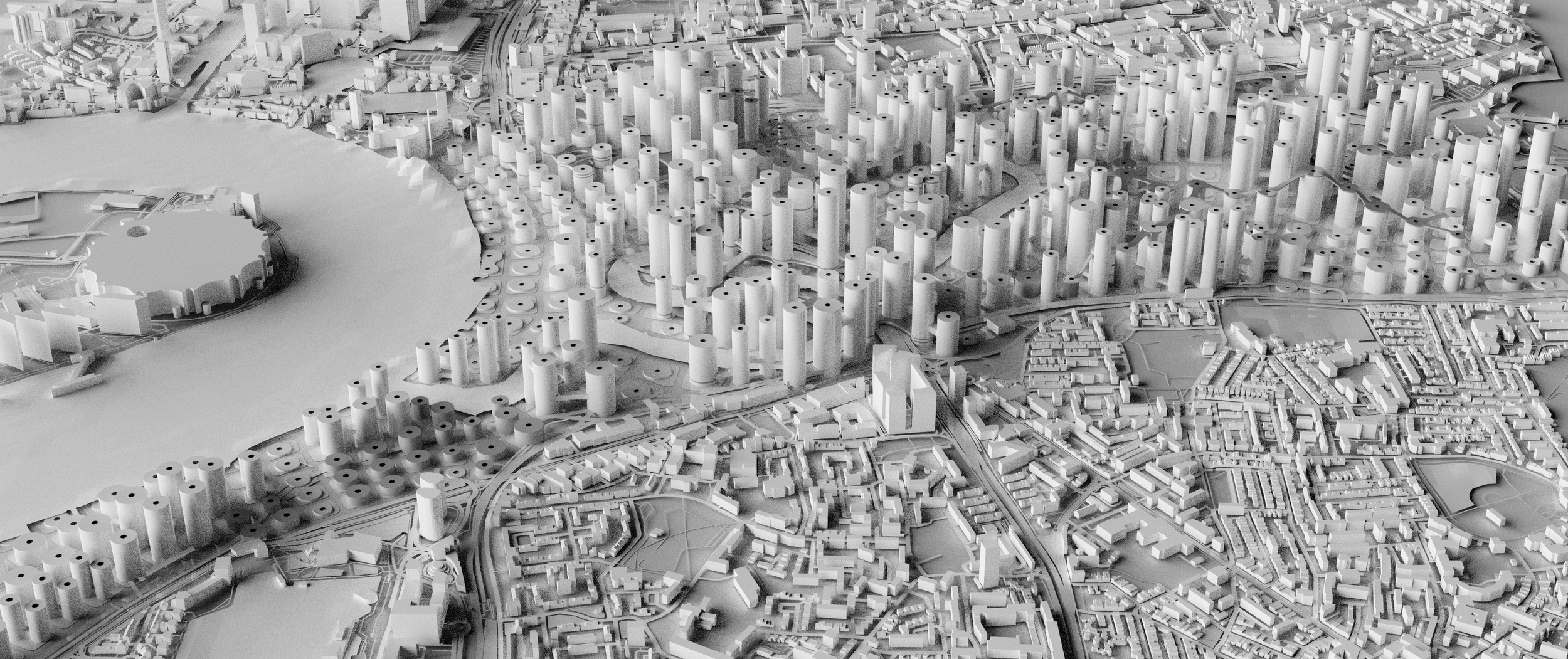
Recognising that the benefits of cities emerge from the density and frequency of interaction between producers and consumers, the lab investigates how these agglomeration dynamics can be extended and accelerated. It explores the development of virtual environments as low-risk sandboxes for rapid urban experimentation, enabling the testing of novel spatial configurations alongside the architectural systems required for their physical realisation.
Through the integration of architecture, computation, and urban systems, the lab investigates how complex environments can be shaped through the design of underlying conditions. It approaches architecture and urbanism as the construction of rule sets, energy landscapes, and interaction frameworks that enable differentiated, adaptive, and scalable forms of organisation.
Research Agenda 2026
AI FOR NEW CITIES
The lab treats AI and new cities not as parallel themes, but as mutually conditioning problems. AI provides new ways to reason about optimisation, negotiation, and adaptation; new cities provide a domain where those capabilities are not optional, but essential. Rather than focusing on the automation of design outcomes, the lab is concerned with locating architectural and urban design agency within both the technical details of AI and the use value of new cities.
In this sense, the lab locates agency upstream of form, operating through the design of geometric energy landscapes and socio-economic game rules, aiming for spatial order to emerge from negotiated equilibria rather than prescribed typologies. Architecture and urbanism are treated not as the direct production of objects or plans, but as the design of the conditions under which form, organisation, and differentiation arise.